Planning & local outreachCreated and managed by One Journey Foundation
Program
Whales of Baja
Stage
Planning & local outreach
Focus area
Pacific coast & Sea of Cortez
Phase 1 target
$60,000 CAD / Todos Santos
The moment behind the mission
One whale. A reason to act.
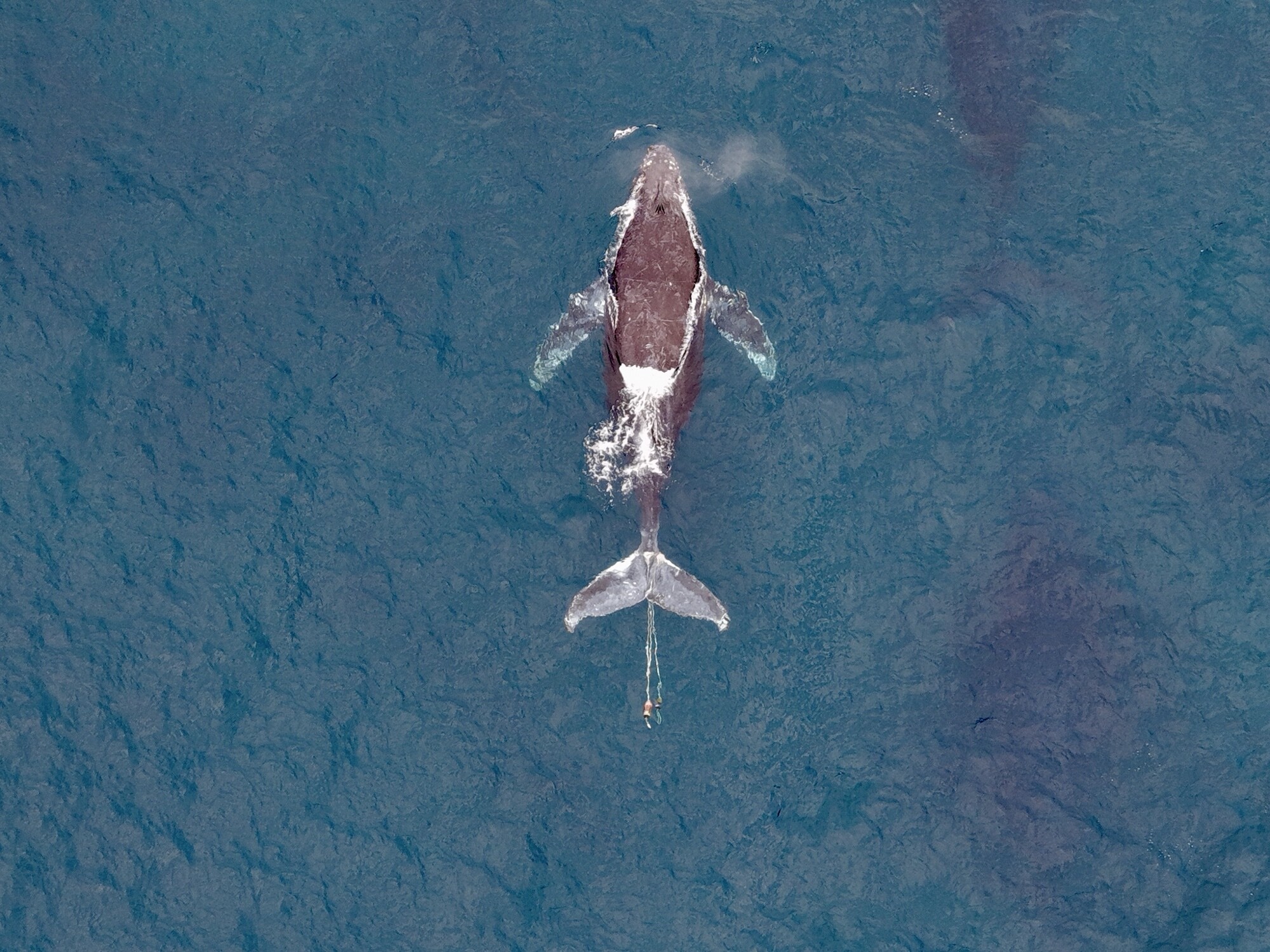
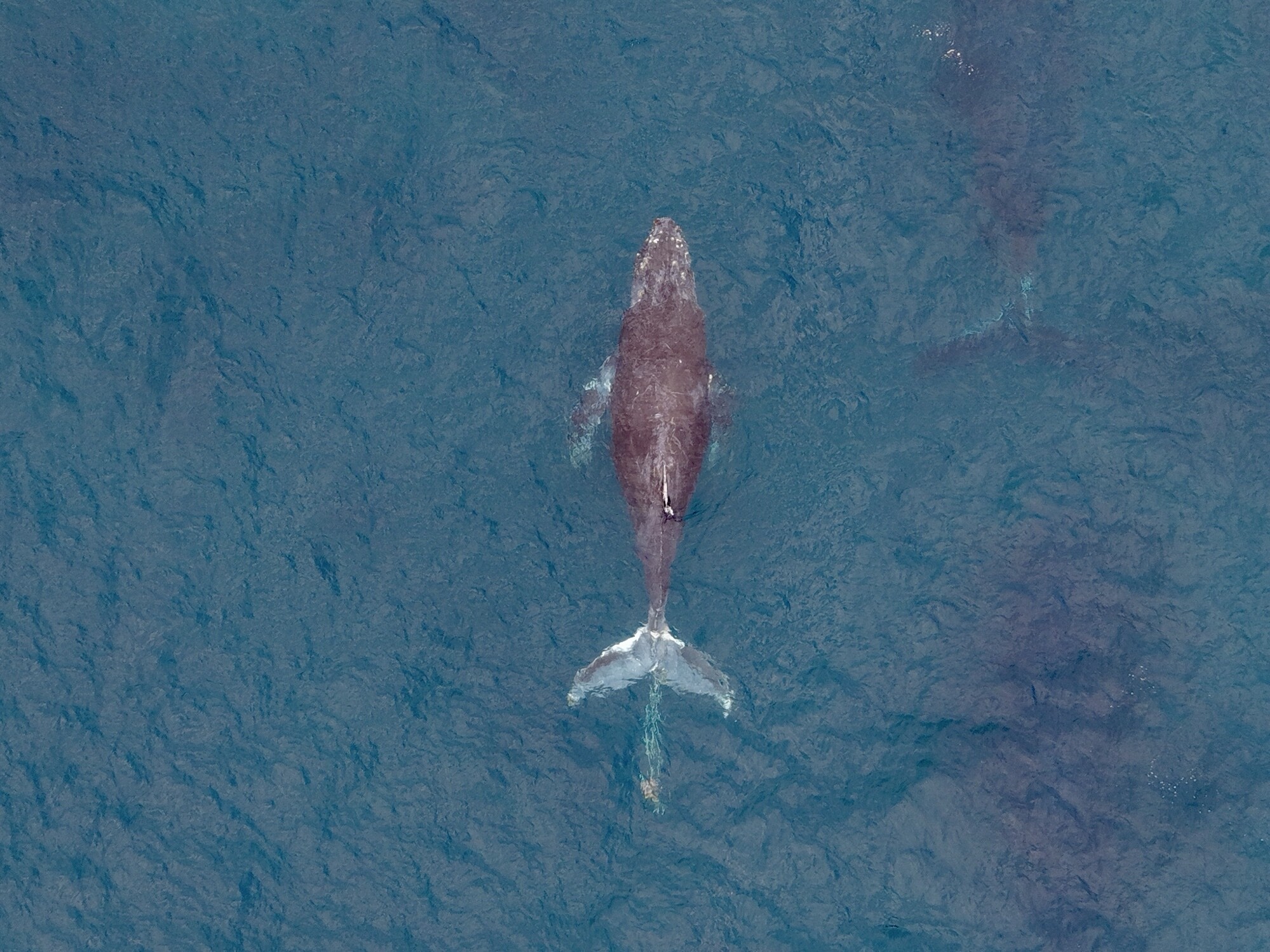
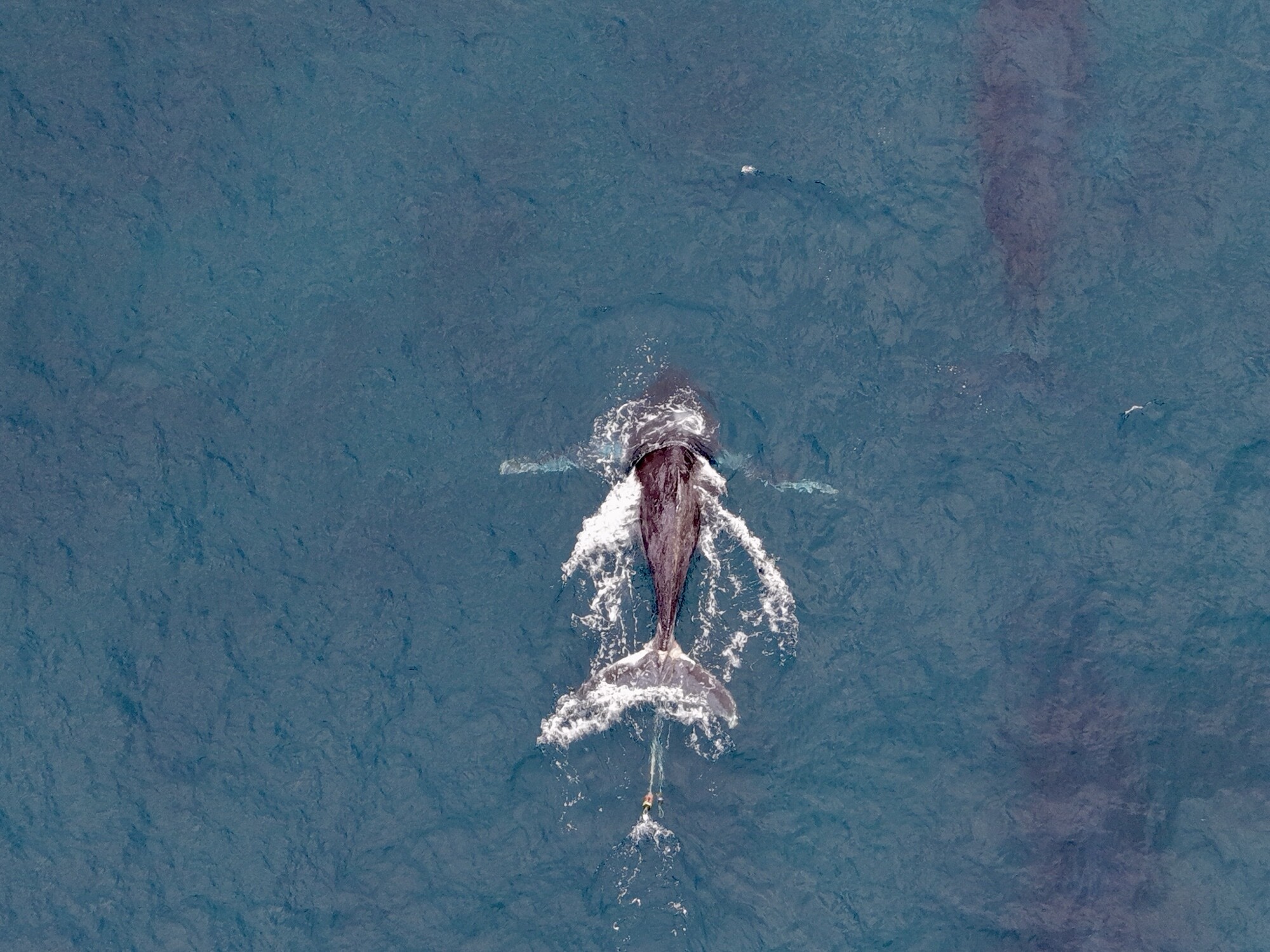
On a trip near Cabo in Baja California Sur, Mexico, Claudia Dargis & Oneil Boulay, Co-founders of One Journey Foundation, saw a whale through a drone with fishing equipment caught on it. That encounter stayed with us. It gave our first project a place, a purpose and a reason to begin.
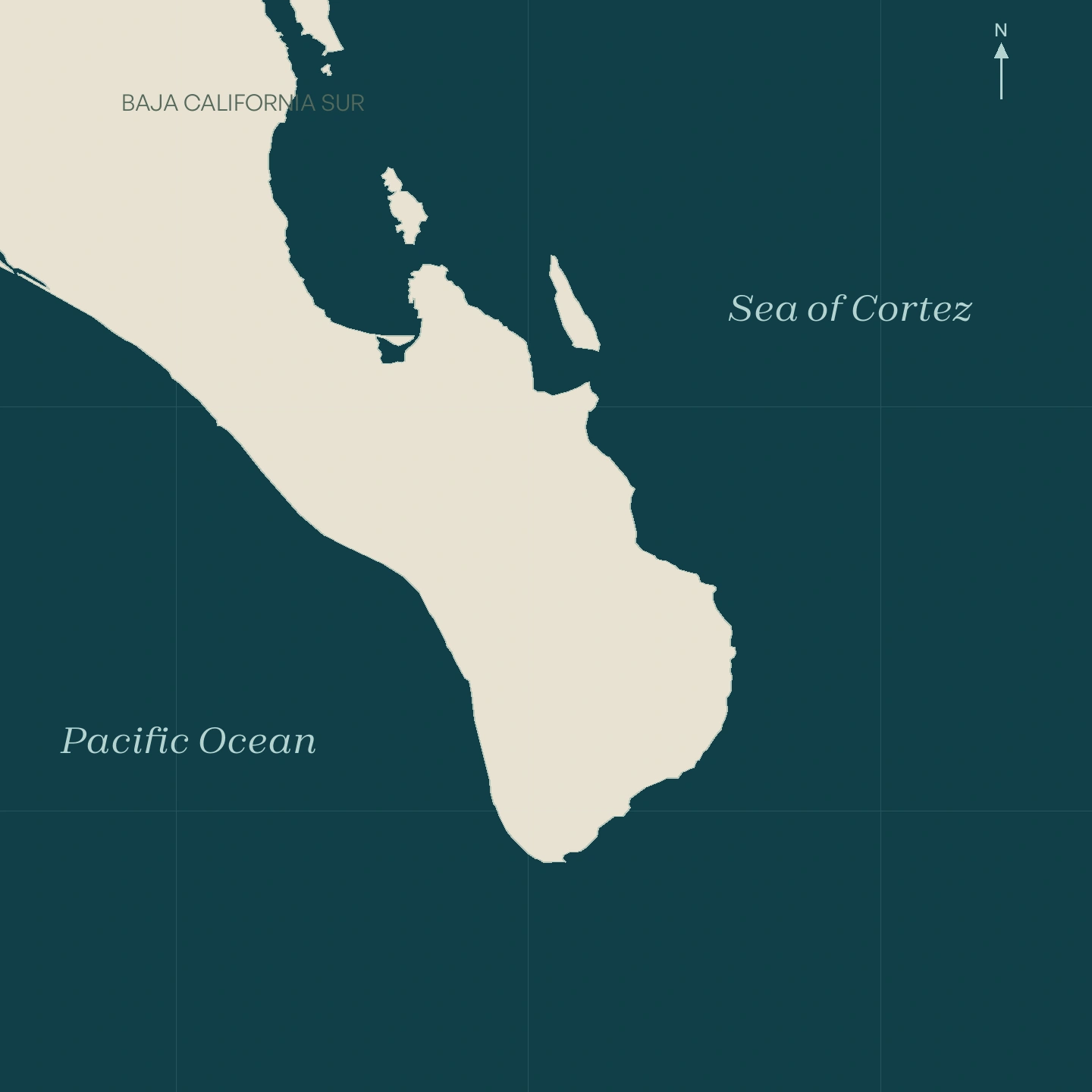
Whales of Baja is the program we will build in response: local networks focused on preventing fishing-gear risks, spotting suspected whale entanglements and getting useful information to trained responders. Its five planned phases will span Baja California Sur’s Pacific coast and the Sea of Cortez.
Outreach has begun. Partners, local teams, dates, permissions and supplier quotes remain unconfirmed. Monitoring and rescue operations are not underway. “Whales of Cabo” may remain the local identity of the Cabo San Lucas phase.
The encounter / Original photographs
What we saw. Why we care.
Three photographs from our co-founder’s drone near Cabo. The full frames are shown here, including the fishing equipment trailing behind the whale.
01 / The sight that started this project.02 / A closer look at the same encounter.03 / Another moment, the same reason to act.
We do not know the eventual outcome for this whale. These images document the encounter, not a rescue.
From our camera
The life worth caring for.
A mother and calf filmed on the trip near Cabo. This is a separate sighting, not footage of a rescue or the entangled whale’s recovery.
Original footage supplied by our co-founder. This clip has no recorded audio. The sightings inspired the project; they are not documentation of completed conservation work.
A coastal strategy / Five planned phases
Different vantage points. One shared purpose.
We chose five complementary coastal locations to create more opportunities to observe whales moving through or using these waters, and to connect useful sightings with local response contacts. We will start in Todos Santos, then build outward as arrangements and funding are ready.
The first local network. A pilot designed to establish the model before expansion.
Why this location
Our Pacific-side starting point will add a coastal observation perspective distinct from the Los Cabos and Sea of Cortez phases. Exact shore-observation sites and schedules will be chosen with local technical guidance.
Planned work
Establish and evaluate the first pilot, adapting all six program components to demonstrated local needs. Coastline mapping will guide reporting-sign placement, including remote access points.
Funding basis
$60,000 CAD working pilot target. Quotes and engagement arrangements are not yet confirmed.
Our intended advantage is complementary viewpoints and local sighting networks, rather than dependence on one observation area. Cabo sits where the Pacific and Sea of Cortez meet; whale opportunities around La Paz are more variable, as described by Oceanic Society. We will adapt each phase to its local activity and access.
A network, not a guaranteed route
Humpbacks transit the Baja peninsula, according to NOAA Fisheries. That does not establish that every whale passes all five locations. Species, seasons, weather and access will affect sightings. Phase numbers describe our planned rollout, not the order whales travel.
Every phase will include all six program components, including coastal reporting signage, adapted to demonstrated local needs. Expansion will depend on funding, local arrangements, permissions and pilot results. Earlier locations will need continued operating budgets, including long-term sign maintenance, alongside expansion. Baja Station is a geographic reference for the East Cape area, not a confirmed partner or operating base.
Six program components
Prevent. Observe. Connect the response.
Reduce fishing-gear risks to whales and help residents and visitors recognise, document, and report suspected entanglements to trained responders. The program is planned and in development. One Journey will lead fundraising, coordination, implementation and reporting, with local participants and specialists supporting delivery. Rescue interventions will remain with authorised responders.
01
Fishing-gear collection
We will establish scheduled pickups from participating fishing communities and arrange sorting, transport and documented delivery to an appropriate existing recycler or disposal provider. Collection arrangements and final destinations will be confirmed locally.
02
Secure fishing-gear storage
We will improve onshore storage and handling at participating sites to keep loose and unwanted gear from blowing or washing into coastal waters. Each site will need clear local responsibility for maintenance and collection.
03
Coastal reporting signage
We will map each phase’s coastline to identify useful placement sites for weather-resistant Spanish–English signs at selected beaches, surf spots, coastal viewpoints, access routes and tourist locations, including remote access points between popular beaches.
Signs will display essential safety and reporting instructions, the confirmed response contact and a site name or location identifier. A QR code and short URL will link to fuller bilingual guidance, but essential instructions must be usable without internet access.
Signage will be included in all five phases. Phase 1 will provisionally target 6–10 signs; later quantities will depend on local geography, site approvals, costs and funding. Each sign will need a local maintenance contact.
04
Public awareness and reporting practice
We will engage fishing groups, residents, hotels, guides, surf businesses and visitors, share technically reviewed reporting resources, and run agreed practice exercises covering location recording, useful documentation and contacting the established response system.
Urgent sightings must go directly to the agreed response contact. One Journey’s recordkeeping must not delay reporting; we will record acknowledged handoffs and follow up on available outcomes.
What an incident report will include
Time and GPS location
Direction of travel
Visible gear
Photographs or video, where safely obtainable
The observer’s contact details
Our teams will not attempt disentanglement. Mexico’s trained response network and safety guidance are described by ECOBAC / RABEN; no partnership or local response arrangement with One Journey is being claimed.
05
Shore-based whale observation
We will establish one local observation team per phase, initially a lead and an observer, supported by a local coordinator. Teams will conduct scheduled sessions from suitable coastal locations selected with local technical advice and teach interested residents responsible observation and reporting.
Records will include observation hours, visibility, conditions, sightings and sessions without sightings. Where a research partner confirms a useful coverage gap, we will contribute records using that partner’s agreed methods. Equipment will support shore observation, documentation, location recording and communications.
Additional participants will be assessed locally. We will not promise continuous surveillance, reliable detection of every entanglement or an independent rescue service. Dedicated drones and boat patrols are not part of the initial delivery model.
06
School education
We will develop a short, age-appropriate lesson with a local educator and deliver it in interested schools. It will cover whales, fishing-gear risks, prevention and safely alerting a responsible adult about a sighting. Children must not approach whales or attempt rescue.
Phase 01 / Todos Santos
Build it locally. Make it last beyond the visit.
The planned pilot will establish fishing-gear collection, secure onshore storage, coastal reporting signage, public awareness and reporting practice, shore-based whale observation, and school education. A paid local coordinator, one observation team, appropriate equipment, specialist input and Spanish–English language support will support delivery. One Journey will manage field setup, financial tracking and public reporting.
01 / Preparation
2–4 weeks
We will confirm local needs, participants, gear destinations, reporting arrangements, observation sites, signage permissions and quotes.
02 / Field setup
Approximately one month
Oneil Boulay (Co-founder & Executive Director) and Claudia Dargis (Co-founder & Director) will coordinate the establishment of collection, storage, signage, training, shore observation and education, supported by local participants and specialists.
03 / Continued local pilot
Approximately six weeks
After their departure, local personnel will maintain activities with remote oversight from One Journey.
04 / Evaluation
Approximately two weeks
We will review results, spending, maintenance and continued operating needs before expansion.
These are proposed durations, not confirmed dates. Dates, final activity quantities and observation schedules remain unconfirmed. This will be scheduled shore-observation coverage, not continuous surveillance.
Phase 01 / Todos Santos pilot
Phase 1 budget and use of funds.
Our $60,000 CAD funding target supports the planning, local setup, implementation, and evaluation of the Todos Santos pilot.
All amounts are CAD planning allocations awaiting supplier quotes and final operating arrangements.
Todos Santos pilot target$60,000 CAD
Planning & local outreach Project donations are open.
The bar shows intended spending allocation, not fundraising progress. Expand each category for every allowance and its purpose.
Program management$15,000
One Journey Foundation program management
$14,000
Compensation for planning, partnerships, community coordination, field implementation, financial oversight, and reporting.
Employment-related costs
$1,000
Applicable employer contributions and related personnel costs.
Field setup assignment$11,000
Airline travel
$2,000
Travel for the Phase 1 field deployment.
Field accommodation
$4,500
Approximately one month supporting local setup and implementation.
Local transportation
$1,800
Transport for meetings, training, observation coordination, and site visits.
Field meals
$2,400
Meals for personnel during the field assignment.
Travel insurance
$300
Coverage for the deployment.
Local delivery & prevention$30,000
Local coordination
$6,000
Scheduling, community relationships, records, equipment oversight, and local continuity.
Gear collection and transport
$4,000
Pickups, sorting, handling, and delivery to confirmed destinations.
Secure gear storage
$3,000
Suitable storage, installation, and handling improvements.
Coastal reporting signage
$3,000
Bilingual design, technical review, weather-resistant fabrication, installation, and an initial maintenance allowance.
Shore-observation personnel
$4,000
Personnel for scheduled observation sessions and field records.
Observation equipment
$2,500
Binoculars, documentation and location tools, communications, and protective storage.
Interpretation and translation
$4,000
Scheduled Spanish–English interpretation and written translation.
Reporting resources and outreach
$2,000
Reporting exercises and practical materials for residents and visitors.
School education pilot
$1,500
Local educator input, teaching resources, and lesson delivery.
Review, costs & contingency$4,000
Evaluation and public reporting
$1,500
Review of activities, finances, and preparation of the public report.
Financial transaction costs
$500
Payment and transfer expenses.
Contingency
$2,000
Additional approved costs within the project scope.
Total Phase 1 funding target$60,000 CAD
Compensation and travel are separate budget lines. One Journey will manage program funds and payments to personnel, local delivery providers, travel providers, equipment suppliers, instructors and language-service providers.
Looking beyond the pilot: the five-location planning envelope
Using $60,000 per location as an initial template would give a $300,000 CAD preliminary five-location setup-and-pilot scenario. It is not a confirmed total program cost. The immediate target remains the $60,000 CAD Todos Santos pilot.
Todos Santos$60,000
Cabo San Lucas$60,000
San José del Cabo$60,000
East Cape$60,000
La Paz$60,000
Later budgets will be adapted using actual costs, local needs, shared resources and workload. Continued operations and long-term sign maintenance will require separate recurring funding, including earlier locations while the network expands.
Accountability / Evidence before claims
Report the work. Not just the intention.
We will track documented activities, spending and local continuity. QR scans, gear collection totals and observation hours will be outreach or activity measures, not proof of reduced entanglements or whales saved. We will not promise a fixed number of rescues or claim a proven reduction in entanglements before results exist.
Gear & storage
Gear collected by type and weight, with documented final destinations. Storage improvements installed, used and maintained.
Signs & participation
Reporting signs installed and maintained; QR engagement as an outreach measure. Participating communities, businesses and schools, and participants’ ability to complete useful practice reports.
Observation & handoffs
Observation sessions, hours, visibility, conditions, sightings and sessions without sightings. Suspected incidents reported, report completeness and acknowledged handoffs to trained responders.
Funds & local continuity
Actual expenditure, remaining funds and whether local activities and maintenance continue. Any verified response outcomes will be clearly attributed to the responding team.
Program updates
Planning & local outreach
Whales of Baja: a five-phase plan
We have developed a planned prevention, observation and reporting model, starting with a $60,000 CAD Todos Santos pilot. Outreach to prospective technical, community and language-service providers has begun. Partners, local teams, dates, permissions and supplier quotes remain unconfirmed; monitoring and rescue operations are not underway.
Our first project: Whales of Cabo
We have narrowed our first project from a broad ocean-cleanup idea to a whale-focused initiative in Cabo, Baja California, Mexico. Our co-founder’s original photographs and mother-and-calf footage introduce the story. The practical action plan, budget and dates are still being developed.
No completed fieldwork or funds raised are reported at this stage.
Protect the Journey
For their future. Starting in Todos Santos.
Help us develop the first local network. You can discuss support for the pilot, express interest in local participation or explore a potential partnership. Participation and partnerships remain unconfirmed.
Planning & local outreach
Todos Santos pilot
$60,000 CAD working funding target. Support Whales of Baja through its dedicated, secure Stripe checkout. The program remains in development.
This is not a call to approach or free an entangled animal. Only trained and authorized responders should attempt disentanglement, as explained by NOAA Fisheries. Seek qualified local response guidance if you encounter wildlife in distress.
Photography and project documentation
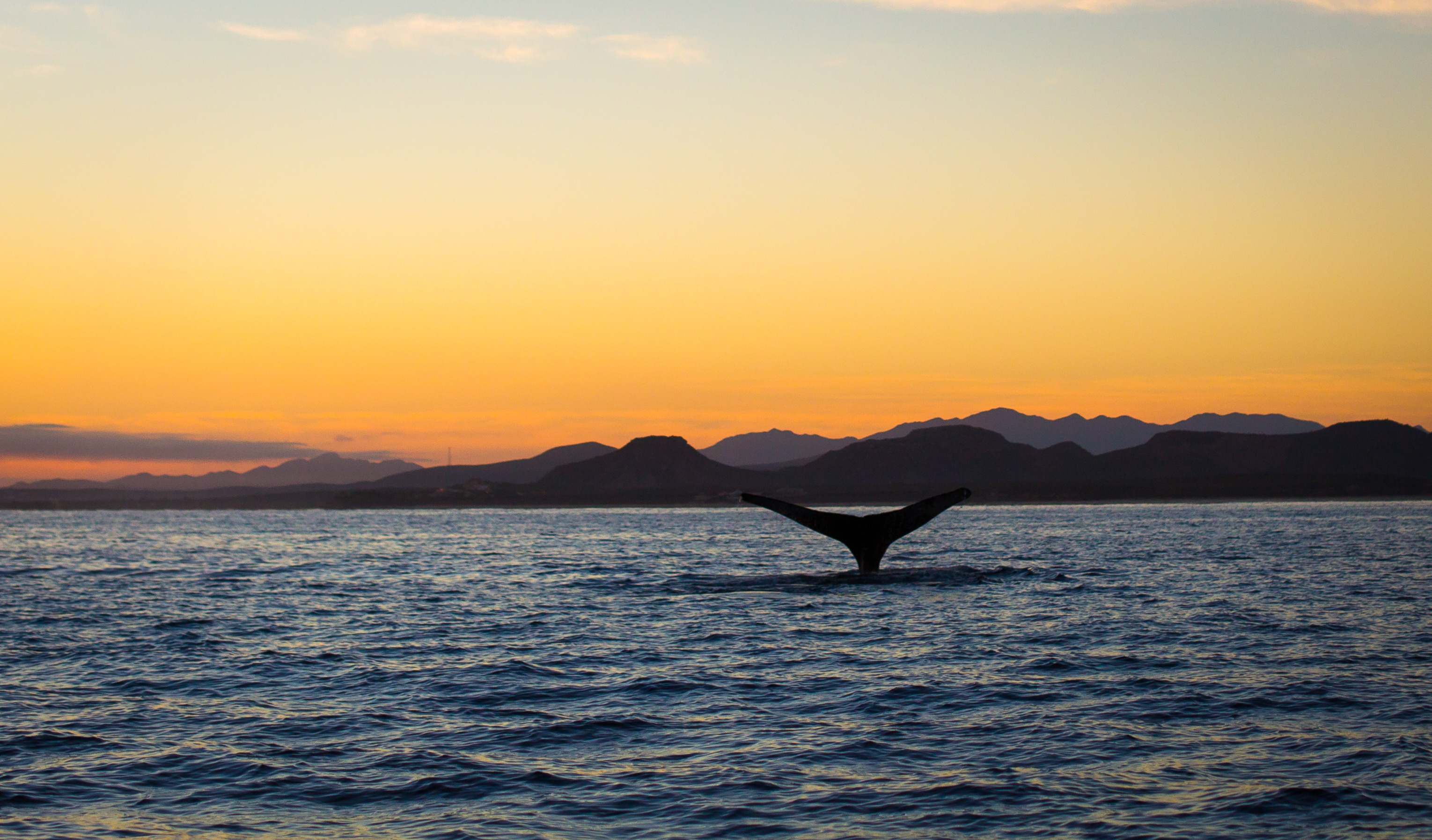
The three encounter photographs and mother-and-calf video are original imagery supplied by our co-founder from the trip near Cabo. The mother and calf are a separate sighting, not the entangled whale or evidence of its recovery. The header photograph, Whale Tale at the Crack of Dawn by Zach Dischner, is reference imagery from Baja’s Sea of Cortez, licensed under CC BY 2.0. It has been compressed for web use and is cropped by the page layout; its exact location in Cabo is not confirmed. The breaching-whale photograph used on our project cards is reference imagery by Todd Cravens, used under the Unsplash License; it was not photographed in Cabo and does not show One Journey fieldwork. No images here document a rescue or completed conservation activity.